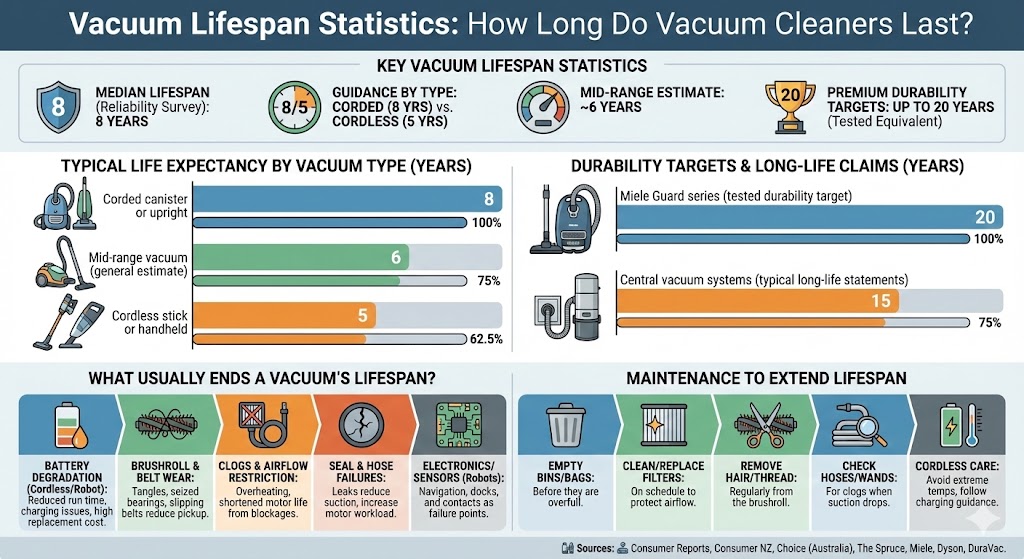
Vacuum lifespan statistics vary by vacuum type, price tier, and maintenance habits. Below are widely cited lifespan benchmarks (survey medians, consumer guidance, and manufacturer durability targets).
vacuum lifespan statistics
Key vacuum lifespan statistics
Median vacuum lifespan in a major reliability survey: 8 years.
Life expectancy guidance by type: 8 years for corded canister/upright vs. 5 years for cordless stick/handheld.
Mid-range vacuum life expectancy estimate: ~6 years.
Some premium manufacturers publicly test/select models for durability equivalent to 20 years of use (based on their stated test assumptions).
Vacuum lifespan statistics by vacuum type
One of the biggest splits in vacuum lifespan statistics is corded vs. cordless. Cordless units often retire earlier because batteries degrade and replacement costs can be a large share of the vacuum’s price.
Vacuum lifespan statistics chart: Typical life expectancy by vacuum type (years)
Label
Bar
Value
Corded canister or upright
8
Cordless stick or handheld
5
Mid-range vacuum (general estimate)
6
Max = 8. Widths: Corded canister or upright 100.00%, Cordless stick or handheld 62.50%, Mid-range vacuum (general estimate) 75.00%.
Median vacuum lifespan statistics from reliability surveys
Survey-based vacuum lifespan statistics are useful because they reflect real-world ownership outcomes. A commonly cited benchmark is a median lifespan of 8 years, which helps reduce distortion from unusually short-lived or extremely long-lived machines.
Manufacturer durability testing and “20-year” targets
Some brands highlight durability testing that targets “equivalent to 20 years of use,” based on the company’s test programs and assumed annual hours. These vacuum lifespan statistics are not the same as a guarantee, but they can signal a design/testing emphasis on long service life.
Vacuum lifespan statistics chart: Durability targets and long-life claims (years)
Label
Bar
Value
Miele Guard series (tested durability target)
20
Central vacuum systems (typical long-life statements)
15
Max = 20. Widths: Miele Guard series (tested durability target) 100.00%, Central vacuum systems (typical long-life statements) 75.00%.
What usually ends a vacuum’s lifespan?
Battery degradation (cordless and robot): run time drops, charging issues appear, replacement cost may be high.
Brushroll and belt wear: tangles, seized bearings, or slipping belts reduce pickup and stress the motor.
Clogs and airflow restriction: blocked hoses/filters can cause overheating and shorten motor life.
Seal and hose failures: leaks reduce suction and increase workload on the motor.
Electronics/sensors (robot vacuums): navigation, docks, and charging contacts can become recurring failure points.
Maintenance steps that most improve vacuum lifespan
Empty bins (or change bags) before they are overfull.
Clean or replace filters on schedule to protect airflow.
Remove hair and thread from the brushroll regularly.
Check hoses and wands for clogs when suction drops.
For cordless vacuums, avoid extreme temperatures and follow the manufacturer’s charging guidance.