Standard smoke alarms may not provide enough warning for people who are deaf, hard of hearing, or difficult to wake. The best smoke detectors for hearing impaired users combine visual strobe lights, bed-shaker or remote alert systems, voice notifications, and dependable backup power.
We’ve gathered 10 options covering dedicated visual alarms, combination smoke and carbon monoxide detectors, hardwired models, and alerting systems that work with existing alarms. Use the guide below to compare alert types, installation requirements, and features before choosing.
Best 10 Smoke Detectors for Hearing Impaired Picks for 2026
Integrated Strobe Protection

- 177-candela visual strobe
- Hardwired with sealed battery backup
- Synchronized, distinct alert patterns
Best For: Integrated visual smoke and carbon monoxide alerts
Voice Alert Value
USI Electric Battery Smoke and CO Alarm

- Smoke and carbon monoxide detection
- Voice alerts for fire and battery changes
- Tamper-proof battery design
Best For: Battery-powered voice notification coverage
Dedicated Visual Alert
First Alert SLED177 LED Strobe

- 177-candela LED strobe
- Synchronized flashing capability
- Slim 120V hardwired design
Best For: Dedicated visual signaling in hardwired systems
Long-Life Dual Sensing

- 10-year sealed battery
- Photoelectric and ionization sensors
- Designed to reduce cooking nuisance alarms
Best For: Low-maintenance smoke-only protection
Best Alerting System Add-On
HomeAware II Basic Starter Kit

- Listens to existing smoke and CO alarm patterns
- Provides strobe, bed-shaker, and scrolling text alerts
- Includes rechargeable battery backup
Best For: Users who need amplified, non-audio warnings from existing alarms
Best Hardwired Combo Detector
Kidde Hardwired Smoke & CO Detector

- Combines smoke and CO detection
- Uses voice alerts and LED indicators
- Includes battery backup and Kidde interconnectivity
Best For: Hardwired homes building an interconnected Kidde alarm system
Best Built-In Strobe
First Alert BRK 7030BSL Combination Alarm

- Includes smoke and CO detection with an LED strobe
- Uses distinct flash patterns for smoke and CO
- Synchronizes strobes across multiple units
Best For: Hearing-impaired residents who prefer an integrated visual alarm
Best Visual Strobe Coverage

- 177-candela LED strobe
- Integrated smoke alarm and strobe
- 10-year sealed battery backup
Best For: Hardwired installations requiring a strong visual alert
Best CO Monitoring With Guidance Light

- Digital CO level display
- 10-year battery backup
- Safety light for emergency guidance
Best For: Supplementing a visual smoke-alert system with CO detection
Best Nuisance-Alarm Control
First Alert Hardwire Strobe Alarm
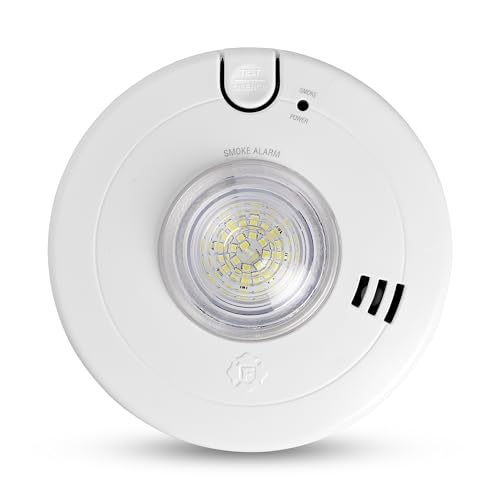
- Integrated LED visual strobe
- Precision Detection technology
- 10-year battery backup
Best For: Hardwired homes seeking visual alerts and fewer cooking nuisance alarms
Integrated Strobe Protection – First Alert BRK 7020BSL
First Alert BRK 7020BSL Hardwired Hearing Impaired Smoke Detector with LED Strobe Light , white
Check Price On AmazonFor shoppers comparing smoke detectors for hearing impaired residents, the First Alert BRK 7020BSL combines a smoke alarm with a bright visual alert. Its 177-candela LED strobe is designed to provide a visible warning, while the hardwired power and sealed battery backup support dependable installation.
Best For: Homes needing an integrated hardwired smoke alarm and visual strobe in one junction box.
Pros:
- 177-candela LED strobe provides a strong visual warning.
- Separate flash patterns distinguish smoke from carbon monoxide alerts.
- Hardwired power includes a 10-year sealed battery backup.
- Multiple units can synchronize their strobes.
Cons:
- Requires hardwired installation and a junction box.
- Front-cover design may vary.
This is a practical choice when visual signaling and a streamlined installation matter more than a standalone battery-only setup.
Voice Alert Value – USI Electric Battery Smoke and CO Alarm
This USI Electric battery alarm is worth considering among smoke detectors for hearing impaired households that also want spoken status information. It detects both smoke and carbon monoxide, provides voice alerts, and is designed for straightforward installation.
Best For: Battery-powered protection with voice notifications for fire and battery replacement.
Pros:
- Detects both fire and carbon monoxide.
- Provides real-time voice alerts for fire and battery replacement.
- Designed to reduce nuisance alarms.
- Tamper-proof design helps deter unauthorized removal.
Cons:
- The supplied notes do not specify a visual strobe or flashing-light alert.
- Battery replacement is part of ongoing ownership.
Its voice-alert approach adds useful information, but shoppers specifically needing a visual warning should verify that it meets their accessibility requirements.
Dedicated Visual Alert – First Alert SLED177 LED Strobe
The First Alert SLED177 is a dedicated LED strobe component for shoppers evaluating smoke detectors for hearing impaired residents. Its 177-candela light delivers a visible warning, and synchronized flashing helps coordinate alerts across multiple compatible units.
Best For: Hardwired installations that need a slim, ceiling- or wall-mounted visual strobe.
Pros:
- Powerful 177-candela LED strobe provides a visual warning.
- Smart strobe feature supports synchronized flashing.
- Slim design mounts on a ceiling or wall.
- 120V quick-connect wiring simplifies installation.
Cons:
- It is listed as a strobe light and does not include the same integrated smoke-alarm functionality as the 7020BSL.
- Requires 120V hardwired installation.
- Supplied notes state there is no warranty.
This model suits projects where a dedicated visual alert is preferred, provided the broader alarm system and compatibility requirements are already planned.
Long-Life Dual Sensing – First Alert SM310 Dual Sensor
The First Alert SM310 focuses on long-term smoke detection for shoppers comparing smoke detectors for hearing impaired homes. Its dual sensors address fast-flaming and slow-smoldering fires, while the sealed 10-year battery avoids routine battery changes and low-battery chirps.
Best For: Battery-powered smoke coverage where dual-sensor detection and low maintenance are priorities.
Pros:
- Dual photoelectric and ionization sensors cover different fire types.
- Sealed 10-year battery eliminates routine battery replacements.
- Precision Detection is designed to reduce cooking nuisance alarms.
- Includes test/silence controls and an end-of-life warning.
Cons:
- The supplied notes do not mention a strobe or other visual alert.
- It detects smoke only, not carbon monoxide.
Choose this model for simple, low-maintenance smoke protection, but pair or replace it with a visual-alert solution if accessibility requires flashing warnings.
Best Alerting System Add-On – HomeAware II Basic Starter Kit
For shoppers comparing smoke detectors for hearing impaired users, the Sonic Alert HomeAware II is an alerting add-on rather than a detector. It listens for the sound patterns from compatible existing smoke and carbon monoxide alarms, then provides strobe, vibration, audio, and scrolling text alerts.
Best For: Deaf or hard-of-hearing users, people who sleep without hearing aids, and heavy sleepers who already have smoke and CO alarms installed.
Pros:
- Combines a bright strobe, bed shaker, scrolling display, and audio tones.
- Can display clear smoke or CO alert notifications.
- Rechargeable battery backup can help during power outages.
Cons:
- Does not detect smoke or carbon monoxide directly.
- Must be placed in the same room as the existing alarm and tested regularly.
- Phone and caller-ID features require additional setup and Bluetooth/app connectivity.
This is a flexible accessibility solution when replacing existing alarms is not practical, but it depends on those alarms sounding correctly and on proper placement.
Best Hardwired Combo Detector – Kidde Hardwired Smoke & CO Detector
For a hardwired option among smoke detectors for hearing impaired households, this Kidde unit combines smoke and carbon monoxide detection with voice alerts and LED indicators. It uses a 120V connection, includes two AA battery backup, and can interconnect with compatible Kidde devices.
Best For: Homes wanting a hardwired smoke and CO detector with battery backup, voice warnings, and compatibility with an interconnected Kidde system.
Pros:
- Combines smoke and carbon monoxide detection in one unit.
- Voice alarm identifies fire, carbon monoxide, or low-battery conditions.
- Supports interconnection with up to 24 Kidde devices, with up to 18 initiating units.
- Includes two-AA battery backup and a 10-year limited warranty.
Cons:
- Its primary alarm is audible, so it may need a separate visual or vibrating alerting device for users who cannot hear it.
- Hardwired installation may be less convenient than a battery-only detector.
- Uses ionization sensing technology, which may not match every household’s preferred sensor type.
This model is a practical foundation for a hardwired safety system, but hearing-impaired residents may benefit from pairing it with a dedicated visual or bed-shaker alert.
Best Built-In Strobe – First Alert BRK 7030BSL Combination Alarm
First Alert BRK 7030BSL Hardwired Hearing Impaired Combination Alarm with Led Strobe Light, White
Check Price On AmazonThe First Alert BRK 7030BSL is designed specifically for hearing-impaired residents who need a visual warning. This hardwired combination smoke and carbon monoxide alarm includes a 77-candela LED strobe, with different flash patterns intended to distinguish smoke from CO alerts.
Best For: Hearing-impaired residents who want an integrated visual alarm rather than a separate strobe accessory.
Pros:
- Combines smoke and carbon monoxide detection with an integrated strobe.
- Separate flash patterns help distinguish smoke and CO alerts.
- Synchronized strobes flash together when multiple units are installed.
- Includes Optipath 360 smoke-sensing technology and a 10-year limited warranty.
Cons:
- It is hardwired, so installation may require existing wiring or professional assistance.
- The supplied notes do not indicate a bed shaker or text display.
- Visual alerts may not be sufficient for users who cannot see the strobe while sleeping.
With its built-in strobe and synchronized multi-unit operation, this is a streamlined choice for households prioritizing visual notification, provided hardwired installation suits the home.
Best Visual Strobe Coverage – BRK Hardwired Smoke Alarm
For shoppers seeking smoke detectors for hearing impaired residents, this BRK unit combines a hardwired smoke alarm with a powerful 177-candela LED strobe. Its visual alarm is designed to provide an alert even when an audible warning may not be noticed.
Best For: Homes needing a hardwired smoke alarm with an integrated, high-intensity visual strobe.
Pros:
- 177-candela LED strobe provides a strong visual warning.
- Integrated smoke alarm and strobe combine two functions in one device.
- Sealed 10-year lithium battery backup supports protection during power outages.
- 1Hz flash rate meets listed ANSI 117.1, NFPA 72, and UL1638 requirements.
Cons:
- Requires corded electric, hardwired installation.
- The supplied information does not specify wireless connectivity or app features.
This is a focused choice when synchronized visual signaling is the priority. When multiple compatible BRK units are interconnected, their strobes flash together for broader coverage.
Best CO Monitoring With Guidance Light – Kidde Plug-In CO Detector
Although it is a carbon monoxide detector rather than a smoke alarm, this Kidde model can complement smoke detectors for hearing impaired households. It plugs into a standard 120V outlet, includes a 10-year battery backup, and displays detected carbon monoxide levels on a digital screen.
Best For: Adding plug-in carbon monoxide monitoring and a safety light to a home protection setup.
Pros:
- Digital LED display shows the carbon monoxide level being sensed.
- 10-year lithium battery backup provides coverage during power outages.
- Safety light can help guide occupants toward safety in dense smoke.
- Peak memory records the last detected CO level or last test.
Cons:
- Detects carbon monoxide, not smoke.
- Its listed alarm type is audible, so it should not be treated as a standalone visual smoke alert.
- Designed for a standard 120V outlet, which may limit placement.
This detector is best viewed as a companion safety device. The display, safety light, test-hush button, and battery backup add useful CO monitoring, but a dedicated visual smoke alarm is still needed for smoke alerts.
Best Nuisance-Alarm Control – First Alert Hardwire Strobe Alarm
First Alert Hardwire Smoke Alarm with 10-Year Battery Backup & LED Light | SM110LED-AC
Check Price On AmazonThis First Alert hardwired model is a practical option among smoke detectors for hearing impaired residents because it pairs an integrated smoke alarm with a powerful LED strobe. Its Precision Detection technology is designed to reduce cooking nuisance alarms while providing early warning.
Best For: Hardwired homes that want visual alerts, interconnectivity, and improved resistance to cooking-related nuisance alarms.
Pros:
- Integrated LED strobe provides a visual warning for hearing impaired residents.
- Precision Detection technology is designed to reduce cooking nuisance alarms.
- 10-year battery backup requires no battery replacements during that period.
- Interconnects with most compatible First Alert and BRK alarms.
Cons:
- Requires corded electric, hardwired installation.
- The supplied details do not specify the strobe’s candela rating or flash rate.
- Compatibility is described as applying to most, rather than all, First Alert and BRK alarms.
Choose this model when reducing cooking-related nuisance alarms matters alongside visual notification. Its interconnect capability can help compatible alarms provide an earlier warning throughout the home.
How We Picked the Best Smoke Detectors for Hearing Impaired Users
We focused on the alert methods that matter most when an audible alarm may not be enough: bright LED strobes, visual status indicators, voice alerts, connected alerting systems, and reliable battery backup. We also considered whether each model is hardwired or battery powered, supports interconnection, detects smoke and carbon monoxide, and offers long-term power protection.
Because needs vary by household, this list includes both dedicated hearing-impaired alarms and standard detectors that add useful visual, voice, or connected-alert features. Always confirm local code requirements and verify that the product’s alert method is suitable for the intended room and user.
Quick Comparison
| Feature | What to look for | Best suited to |
|---|---|---|
| LED strobe | Bright flashing visual warning | Users who can see the alarm from sleeping or living areas |
| Connected alert system | Remote notifications, bed shaker, or accessory alerts | Deep sleepers or users who may not see a wall-mounted alarm |
| Voice alerts | Spoken smoke, fire, or CO warnings | People who can hear amplified or clearly spoken notifications |
| 10-year battery | Long-life backup with less maintenance | Homes where frequent battery changes are difficult |
| Hardwired interconnect | Linked alarms throughout the home | New installations or homes with compatible wiring |
Key Buying Factors for Smoke Detectors for Hearing Impaired
Choose the Right Alert Pathway
A strobe light is useful only when it is visible. Consider mounting position, bedroom layout, lighting, and whether doors or walls could block the flash. For sleepers, a compatible bed shaker or remote receiver can provide a more dependable wake-up signal. Voice alerts may add useful information but should not replace visual or tactile alerts when hearing is limited.
Check Installation and Compatibility
Hardwired alarms can offer interconnection and may be required by local building codes, but installation should match the existing wiring and connector type. Battery models are easier to install, while 10-year sealed batteries reduce maintenance. Do not assume alarms from different brands or product families can be interconnected.
Consider Smoke and Carbon Monoxide Coverage
Combination alarms can reduce the number of devices needed and provide protection against two hazards. However, confirm sensor type, placement guidance, and whether the device’s visual or remote alert works for both smoke and CO events.
Plan for Testing and Maintenance
Test alarms regularly, keep sensors free of dust, replace units according to the manufacturer’s service life, and maintain a clear path for visual or connected alerts. A complete system may require testing every accessory, receiver, and backup battery—not just the detector itself.
Who Should Buy Which Smoke Detectors for Hearing Impaired?
- Choose a strobe-light alarm if a bright visual warning is visible from the bedroom or main living areas.
- Choose a connected alerting kit if the user is a heavy sleeper, may not see a wall-mounted strobe, or needs a bed shaker or remote notification.
- Choose a hardwired interconnected model for a compatible home installation where an alarm in one area should trigger alarms throughout the property.
- Choose a 10-year battery model when simple installation and reduced battery maintenance are the priorities.
- Choose a combination smoke and CO detector when you want both hazards covered in one device, while confirming that its alert style meets the user’s needs.