The best shoe cabinets make crowded entryways easier to manage without taking up unnecessary floor space. This roundup compares 10 options designed for different homes, from narrow flip-drawer units to tall covered racks and decorative farmhouse cabinets.
Use the guide below to match cabinet capacity, dimensions, accessibility, and style with your footwear collection and available storage area.
Best 10 Shoe Cabinets Picks for 2026
Warm Entryway Storage

- Two flip drawers hold about 14 pairs of adult shoes
- Narrow 9.4-inch depth saves entryway floor space
- Thick top supports up to 80 pounds
Best For: Small entryways needing concealed shoe storage
Farmhouse Organization
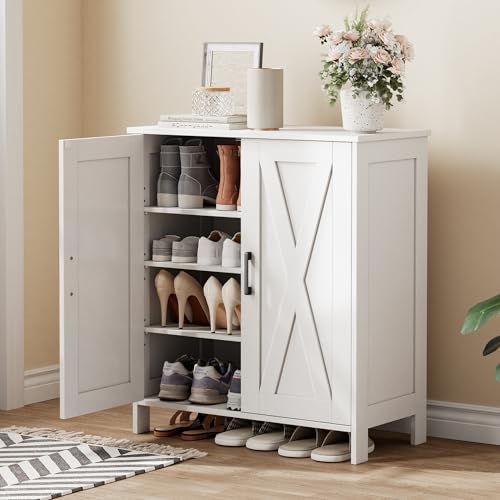
- Three adjustable shelves fit varied shoe sizes
- Holds 15 or more pairs in five-tier storage
- Includes wall anchoring for added stability
Best For: Farmhouse entryways needing flexible enclosed storage
Maximum Vertical Capacity

- Stores approximately 40 to 50 pairs
- Removable waterproof cover helps block dust
- Removable tier accommodates taller boots
Best For: Large collections with room for tall vertical storage
Flexible Farmhouse Storage

- Adjustable shelf fits heels through ankle boots
- Open and closed compartments improve organization
- Stores approximately 9 to 12 pairs
Best For: Entryways wanting flexible mid-capacity storage
Best Farmhouse Style

- Slim 9.5-inch profile for tight spaces
- Two flip drawers hide everyday footwear
- Adjustable dividers and top display fence
Best For: Rustic entryways needing compact hidden shoe storage
Best for Maximum Visibility
7-Tier Rotating Shoe Rack Tower

- Seven vertical tiers maximize storage
- 360-degree rotation improves access
- Open shelves can hold shoes and accessories
Best For: Visible organization in closets, bedrooms, and entryways
Best for Adjustable Family Storage
White Flip-Drawer Shoe Cabinet

- Stores up to 16 pairs across four tiers
- Adjustable shelves fit varied footwear
- Narrow design with dust-protective flip drawers
Best For: Compact family entryways needing flexible concealed storage
Bohemian Entryway Pick

- Stores up to 12–16 pairs
- Adjustable shelves and breathable doors
- Natural-oak engineered-wood design
Best For: Stylish everyday entryway storage
Compact Modern Pick

- Slim 9.5-inch-deep profile
- Stores about 14 adult pairs
- 80-pound tabletop and anti-tip device
Best For: Small entryways and narrow hallways
Maximum-Capacity Pick

- Holds up to 72 pairs
- 12 tiers with removable cubes
- Waterproof, wipe-clean PP plastic
Best For: Large collections and flexible storage spaces
Warm Entryway Storage – Modern Walnut Shoe Cabinet
This modern shoe cabinet is a practical choice for narrow entryways that need concealed storage. Its two flip drawers hold about 14 pairs of adult shoes, while the 9.4-inch depth helps conserve floor space. The walnut finish, thick top, and rose-colored handles add a furniture-like look.
Best For: Small entryways and households wanting enclosed shoe storage with a decorative surface.
Pros:
- Stores about 14 pairs of adult shoes in two flip drawers.
- Narrow 9.4-inch depth suits areas with limited floor space.
- Thickened top supports up to 80 pounds for keys, plants, and other items.
- Includes an anti-tipping device and clear, numbered assembly instructions.
Cons:
- Its stated capacity may not suit larger shoe collections.
- Boot storage may require removing the center divider.
- Assembly is required.
This cabinet balances compact dimensions with concealed storage and a useful top surface. Consider it when appearance and entryway width matter as much as capacity.
Farmhouse Organization – Barn-Door Shoe Cabinet
This farmhouse shoe cabinet combines enclosed storage with adjustable shelving for a flexible entryway setup. Measuring 13.8 by 27.6 by 31.5 inches, it accommodates 15 or more pairs and can also store bags, accessories, or everyday essentials.
Best For: Farmhouse-style entryways needing adjustable, enclosed storage for shoes and household items.
Pros:
- Three adjustable shelves accommodate different shoe sizes, including boots.
- Five-tier storage holds 15 or more pairs.
- Barn doors, black handles, white finish, and wood legs suit farmhouse décor.
- Includes assembly tools, instructions, and a wall-anchoring device.
Cons:
- At 13.8 inches deep, it needs more floor space than narrower cabinets.
- Assembly is required.
- Particleboard construction may not have the same feel as solid wood.
With adjustable shelves and a versatile cabinet format, this model is more adaptable than a basic fixed shoe rack. Its larger footprint makes it better suited to rooms with moderate entryway space.
Maximum Vertical Capacity – Covered 10-Tier Shoe Rack
For shoppers prioritizing capacity, this tall shoe rack provides 10 tiers of vertical storage for approximately 40 to 50 pairs. Its removable waterproof cover helps shield footwear from dust and dirt, while the 9.8-inch depth keeps the footprint relatively compact.
Best For: Large shoe collections in closets, dorms, bedrooms, garages, or other spaces with available vertical room.
Pros:
- 10 tiers provide storage for approximately 40 to 50 pairs.
- Removable waterproof cover protects shoes from dust and is easy to clean.
- Four cover pockets hold small accessories such as keys, ties, and belts.
- One tier can be removed to create more room for long boots.
Cons:
- At 62.2 inches tall, it may not suit spaces with limited vertical clearance.
- The covered rack has a less furniture-like appearance than a hard-sided shoe cabinet.
- Assembly is required.
This rack is a strong capacity-first alternative to compact shoe cabinets. Choose it when maximum storage and dust protection outweigh the need for solid cabinet doors.
Flexible Farmhouse Storage – VASAGLE 3-Tier Shoe Cabinet
This VASAGLE shoe cabinet offers a mix of open and closed storage in a rustic white and honey-brown design. Its adjustable upper shelf helps accommodate footwear from high heels to ankle boots, while four storage layers hold approximately 9 to 12 pairs.
Best For: Entryways and living spaces needing a mid-capacity cabinet with adjustable and open storage.
Pros:
- Adjustable shelf uses five height positions spaced 3 cm apart.
- Open and closed compartments provide flexible organization.
- Holds approximately 9 to 12 pairs in a 31.5-inch-wide cabinet.
- Raised base makes cleaning underneath easier.
Cons:
- Capacity is lower than taller, multi-tier shoe racks.
- At 13.8 inches deep, it requires more depth than narrow flip-drawer cabinets.
- Assembly is required.
This model suits shoppers who want a coordinated farmhouse look without giving up shelf adjustability. Its moderate capacity and combination of open and closed compartments make it a flexible everyday organizer.
Best Farmhouse Style – Slim Barn-Door Shoe Cabinet
For shoppers who want shoe cabinets that contribute to a room’s decor, this farmhouse-style organizer combines hidden storage with a black barn-door-inspired look. Its 9.5-inch depth suits narrow entryways, while two flip drawers, adjustable dividers, and four compartments help keep everyday footwear contained.
Best For: Small entryways, foyers, and hallways where rustic styling and slim hidden storage matter.
Pros:
- Narrow 9.5-inch profile helps conserve floor space.
- Two flip drawers conceal shoes and provide easy access.
- Removable dividers let you adjust compartment space.
- Top fence, raised legs, and wall-anchoring hardware add practical utility.
Cons:
- Engineered-wood construction may not have the feel of solid wood.
- Four compartments may be limiting for larger shoe collections.
- Assembly is required.
This is a decorative, space-conscious choice for buyers who want shoe cabinets to look like part of their entryway furniture. The slim design and adjustable storage are useful, but shoppers with extensive collections may need additional storage.
Best for Maximum Visibility – 7-Tier Rotating Shoe Rack Tower
Among shoe cabinets and organizers, this rotating tower stands out for its vertical, open-display design. Seven tiers revolve 360 degrees so shoes remain visible and accessible, while the 63-inch height uses vertical space in closets, bedrooms, or entryways.
Best For: Shoe collections that benefit from open visibility, compact floor placement, and quick access.
Pros:
- Seven tiers provide substantial vertical storage.
- 360-degree rotation makes shoes easier to see and reach.
- Can also hold handbags, hats, and other accessories.
- Freestanding design is designed for home assembly.
Cons:
- Open shelves do not hide shoes from view or dust.
- At 63 inches tall, it may not suit rooms with limited vertical clearance.
- The 23.2-inch footprint is wider than a narrow flip-drawer cabinet.
This tower is a practical alternative to traditional shoe cabinets when visibility and capacity are priorities. Its rotating format can simplify daily selection, though the open construction is less suitable for shoppers seeking concealed, dust-protected storage.
Best for Adjustable Family Storage – White Flip-Drawer Shoe Cabinet
This white shoe cabinet is designed for compact entryways, offering four tiers and room for up to 16 pairs in a 9.45-inch-deep profile. Two flip drawers protect footwear from dust and pets, while removable or repositionable shelves accommodate different shoe types.
Best For: Families or households needing concealed, adjustable shoe storage in a narrow hallway or entryway.
Pros:
- Four tiers are designed to hold up to 16 pairs.
- Adjustable shelves can accommodate heels, boots, and other footwear.
- 60-degree flip-door opening helps reduce bending during retrieval.
- Metal frame, anti-tip kit, and 60-pound top-surface capacity add stability and utility.
Cons:
- Assembly is required.
- Its narrow depth may limit storage for especially bulky footwear.
- Closed drawers offer less at-a-glance visibility than open shoe racks.
With a compact footprint, adjustable interior, and protected flip-door storage, this is one of the more versatile shoe cabinets for busy entryways. It offers useful capacity without taking much depth, provided the collection fits within its four-tier layout.
Bohemian Entryway Pick – Rattan Shoe Storage Cabinet
This rattan shoe cabinet combines concealed storage with a warm natural-oak finish, making it a practical choice for an entryway, hallway, or living room. Its adjustable shelves accommodate different footwear, while the breathable rattan-style doors help promote airflow.
Best For: Shoppers wanting stylish, enclosed shoe storage for roughly 12–16 pairs.
Pros:
- Holds up to 12–16 pairs with adjustable shelving for boots, heels, and sneakers.
- Rattan-weave doors provide airflow while keeping footwear out of sight.
- Natural-oak finish and metal hardware suit rustic, modern, or Bohemian décor.
- Top supports up to 33 pounds, and assembly hardware and instructions are included.
Cons:
- Its 13.8-inch depth may not suit especially bulky footwear.
- The engineered-wood cabinet requires assembly.
With a relatively compact footprint and decorative doors, this is a balanced shoe cabinet for everyday entryway organization. Choose it if appearance and concealed storage matter more than maximum capacity.
Compact Modern Pick – Narrow 2-Drawer Shoe Cabinet
This narrow shoe cabinet is designed for spaces where floor depth is limited. The two flip drawers store about 14 pairs of adult shoes, while the thickened top provides a useful surface for keys, wallets, plants, or other entryway essentials.
Best For: Small entryways needing a slim, modern shoe cabinet with a usable tabletop.
Pros:
- Approximately 9.5 inches deep, making it suitable for narrow hallways and entryways.
- Stores about 14 pairs of adult shoes, or up to about 20 pairs of children’s shoes.
- Thickened desktop supports up to 80 pounds.
- Includes an anti-tipping device that can be secured to the wall.
Cons:
- Larger boots may require removing the center divider.
- Its two-compartment design offers less capacity than larger shoe storage cabinets.
- Assembly is required.
The slim profile and heavy-duty top make this a useful option for apartment hallways or compact foyers. It is best suited to everyday shoes rather than a large collection or oversized boots.
Maximum-Capacity Pick – 72-Pair Portable Shoe Rack
For households needing substantial shoe storage, this tall shoe cabinet offers 12 tiers and room for up to 72 pairs. Its covered cubbies protect footwear from dust, while removable cubes and hooks allow the organizer to be configured for shoes, bags, clothing, accessories, or other household items.
Best For: Families, closets, garages, dorms, or anyone organizing a large footwear collection.
Pros:
- Large 72-pair capacity across 12 tiers and 36 shelves.
- Removable cubes can be arranged into different configurations.
- Waterproof PP plastic is easy to clean with a damp cloth.
- Frosted doors help conceal contents while door openings support air circulation.
Cons:
- The 72-inch height requires substantial vertical space.
- Plastic construction may look less furniture-like than engineered-wood shoe cabinets.
- Nonstandard configurations may result in missing or redundant parts, according to the supplied notes.
This organizer prioritizes capacity and flexibility over a compact, furniture-style profile. Its tall modular structure is particularly useful when a conventional shoe cabinet cannot hold the whole household’s footwear.
How We Picked These Shoe Cabinets
We focused on practical storage features rather than appearance alone. The selection covers slim entryway cabinets, tall open or covered racks, rotating towers, adjustable shelves, and furniture-style designs. We also considered stated capacity, accessibility, footprint, ventilation, construction details, and how easily each format can fit into an entryway, closet, bedroom, or mudroom.
Because shoe sizes and styles vary, listed pair counts should be treated as estimates. Boots, high-tops, and bulky athletic shoes typically require more room than flats or sandals.
Quick Comparison
- Best for narrow entryways: Slim cabinets with flip drawers and vertical compartments.
- Best for a farmhouse interior: Barn-door cabinets with wood legs and traditional detailing.
- Best for maximum capacity: Tall 10-tier or 72-pair covered organizers.
- Best for visibility: Open racks or a rotating shoe tower.
- Best for flexible storage: Cabinets with height-adjustable shelves.
- Best for decorative styling: Rattan-front and furniture-style cabinets.
Key Buying Factors for Shoe Cabinets
Measure the Footprint First
Check the cabinet’s width, depth, and height against the intended wall or corner. A slim cabinet can preserve walking space, while a tall rack may provide more capacity without requiring much floor area. Confirm that doors or drawers can open fully without hitting walls, furniture, or the main entry path.
Match Capacity to Your Footwear
Count the pairs you plan to store and leave some spare room for seasonal additions. Flip drawers are useful for everyday shoes and keep the front of the cabinet tidy, but tall boots may need open shelves or a larger compartment. High-capacity covered racks are better suited to extensive collections or shared households.
Consider Access and Organization
Open shelving makes shoes easy to identify, while doors and covers create a cleaner look and help reduce visible clutter. Rotating designs can improve access in tight spaces. Adjustable shelves are especially useful when your collection includes shoes of different heights.
Check Stability, Materials, and Airflow
Look for a stable base and follow any included anti-tip guidance, particularly for tall units. Engineered wood, metal, fabric, and rattan-style finishes each offer a different balance of appearance, weight, and durability. Shoes should be reasonably dry before being placed in enclosed storage; ventilation is helpful for frequently worn footwear.
Who Should Buy Which Shoe Cabinets?
Choose a slim flip-drawer cabinet if your priority is a tidy entryway with a small footprint. These units suit apartments, hallways, and households that mainly store everyday shoes.
Choose a tall covered organizer if capacity and dust protection matter most. It is a practical choice for closets, bedrooms, or larger families with many pairs.
Choose a farmhouse or rattan cabinet if the storage piece needs to complement your décor as well as organize shoes. These designs work best where the cabinet remains visible.
Choose an adjustable-shelf cabinet for mixed footwear, while a rotating rack makes sense when quick access and compact vertical storage are more important than concealed storage.